Joseph Schooling's Journey: From Childhood Dream to Singapore's First Olympic Gold
How family sacrifice, American training and an Olympic record over Michael Phelps shaped the life of Singapore's greatest swimmer.
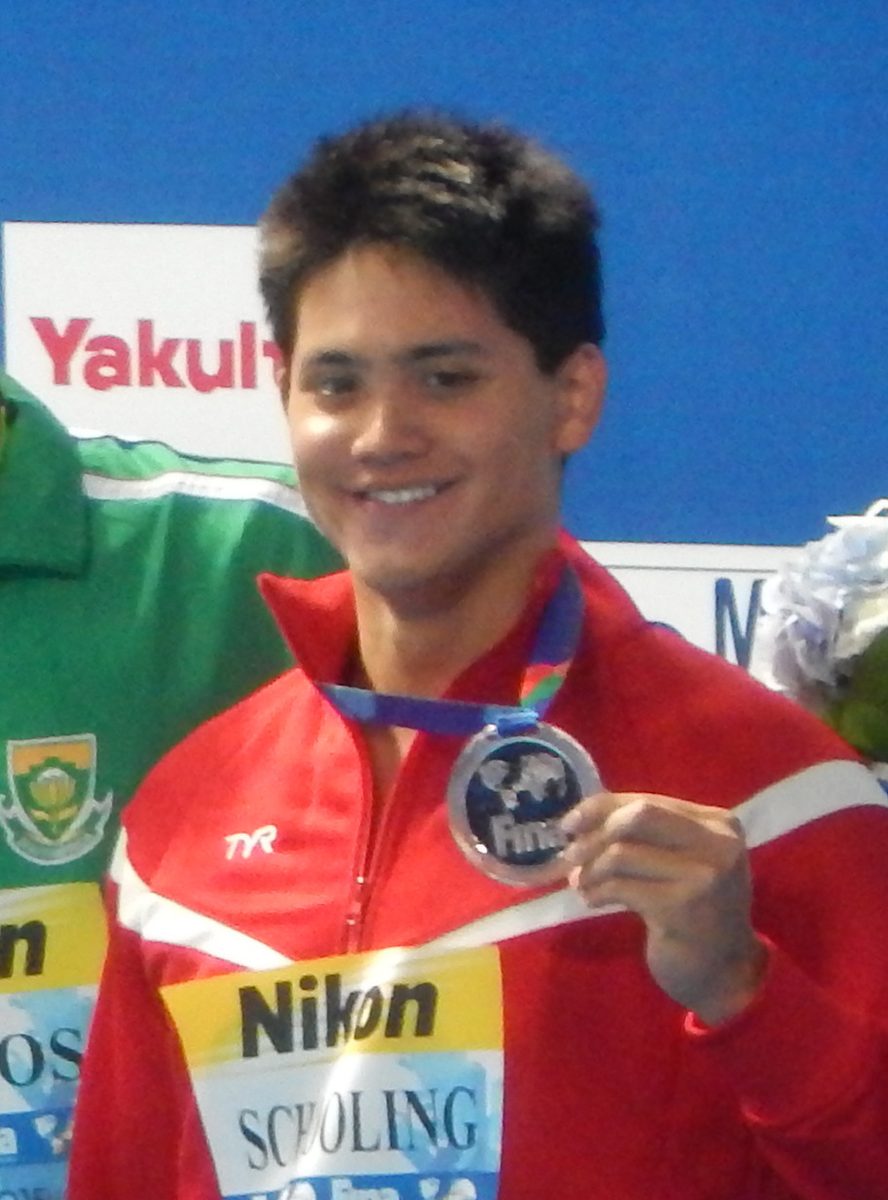
On 12 August 2016, 21-year-old Joseph Isaac Schooling entered lane four at the Olympic Aquatics Stadium in Rio de Janeiro and stopped the clock in 50.39 seconds. That swim took 0.19 seconds off Michael Phelps's 2008 Olympic record, forced Phelps, Chad le Clos and László Cseh into an unprecedented three-way tie for silver at 51.14 seconds, and delivered Singapore's first and only Olympic gold medal. Born on 16 June 1995 to Colin and May Schooling, the fourth-generation Singaporean had pursued that specific wall touch since boyhood, tracing a lineage of Olympic ambition that began almost seven decades earlier.
Schooling's Olympic motivation originated with his grand-uncle Lloyd Valberg, a high jumper who competed at the 1948 London Games as Singapore's first Olympian. Schooling was raised in Singapore as the only child in a sporting household: his father Colin, educated at Raffles Institution, represented Singapore in softball after competing in water polo and hurdles, while his mother May had played professional tennis in Malaysia before moving from Perak. After attending Anglo-Chinese School (Junior) and Anglo-Chinese School (Independent), Schooling met Phelps in Singapore in 2008 when the American stopped over ahead of the Beijing Games. A photograph captured the 13-year-old Singaporean standing beside his swimming idol.
Determined to pursue world-class competition, Schooling left Singapore in 2009 at age 14 to attend the Bolles School in Jacksonville, Florida, training under Spanish Olympic medallist Sergio López Miró. The relocation required significant financial and family sacrifice. Colin and May Schooling sold a residential property in Australia and spent more than S$1 million to finance their son's coaching, schooling and living costs, alternating shifts between Jacksonville and Singapore to run their business while supporting him.
From London Heartbreak to Asian Games Glory
Schooling earned his first Olympic "A" qualifying standard at the 2011 Southeast Asian Games in Palembang, winning the 200m butterfly in 1:56.67. His Olympic debut at the 2012 London Games, however, ended in disappointment. Minutes before his 200m butterfly heat at the London Aquatics Centre, swimming officials rejected his swim cap and goggles for non-compliance with equipment rules. Forced to scramble for replacements before the buzzer, Schooling clocked 2:01.31, finished 26th overall, and missed the semi-finals.
The setback launched an accelerated climb. In July 2014, Schooling became Singapore's first swimming medallist at the Commonwealth Games, securing silver in the 100m butterfly in Glasgow. Two months later at the Incheon Asian Games, he won bronze in the 200m butterfly, silver in the 50m butterfly, and gold in the 100m butterfly with a Games record of 51.76 seconds, ending a 32-year title drought for Singapore's male swimmers. Later that year, he enrolled at the University of Texas at Austin to swim for Hall of Fame coaches Eddie Reese and Kris Kubik. In June 2015, Schooling collected nine gold medals and nine Games records at the Southeast Asian Games on home soil, clocking 22.47 seconds in the 50m freestyle to erase Ang Peng Siong's 33-year-old national record. Two months later at the Kazan World Championships, he took bronze in the 100m butterfly with an Asian-record time of 50.96 seconds, securing Singapore's first world aquatics medal.
The Rio Pinnacle and Collegiate Supremacy

Schooling arrived at the Rio 2016 Olympics following a dominant collegiate run for the Texas Longhorns, where he set NCAA and US Open records of 44.01 seconds in the 100-yard butterfly and 1:37.97 in the 200-yard butterfly. In Rio's 100m butterfly semi-finals on 11 August, he qualified fastest in an Asian record of 50.83 seconds. In the final on 12 August, Schooling opened with a split of 23.64 seconds at the halfway mark before finishing in 50.39 seconds, beating Phelps, Le Clos and Cseh by 0.75 seconds.
The swim earned Schooling S$1 million under Singapore's Multi-Million Dollar Award Programme, with 20 percent reinvested into the Singapore Swimming Association for youth development. The NCAA cleared the payment under regulations governing state rewards to foreign student-athletes. Upon his return, tens of thousands lined Singapore's streets for an open-top bus victory parade. Swimming outlet SwimSwam ranked the performance fourth on its list of the top swims of 2016, behind Katinka Hosszú, Katie Ledecky and Adam Peaty.
Adversity, National Service and Life After the Pool
Schooling completed his collegiate swimming career at Texas in 2017 with 12 NCAA titles (four individual and eight relays). At the 2017 Budapest World Championships, he claimed joint bronze in the 100m butterfly (50.83 seconds) behind Caeleb Dressel. He defended his 100m butterfly crown at the 2018 Jakarta Asian Games in 51.04 seconds and added the 50m butterfly title. However, technical adjustments, weight fluctuations and coaching transitions disrupted his preparation for the delayed Tokyo 2020 Olympics. In Tokyo in July 2021, Schooling finished 44th in the 100m butterfly heats with a time of 53.12 seconds, exiting in the preliminary round.
Personal loss followed four months later when his father Colin died of cancer on 18 November 2021 at age 73. In January 2022, Schooling enlisted for Singapore's mandatory National Service. In August 2022, he received an official censure from the Singapore National Olympic Council after admitting to consuming cannabis overseas while on leave during the Southeast Asian Games in Hanoi, resulting in the withdrawal of his sports training privileges for the remainder of his military term.
On 2 April 2024, at age 28, Schooling announced his retirement from competitive swimming. In business, he directs his academy, Swim Schooling, and operates as a founding partner at venture capital firm Swaen Schooling Capital alongside Cliff Go and Ben Ling. In 2025, the International Swimming Hall of Fame confirmed his induction as its first Singaporean member, capping a career that redefined Southeast Asian swimming.