Cambodian Premier League: Better Clubs, Small Crowds. A Club-by-Club Look at How to Build Fans
Cambodian clubs are winning in Asia, yet league matches average about 1,300 spectators. Data on all 11 clubs, Angkor Tiger's rise in Siem Reap, and lessons from Japan and Thailand point to what each club can do.
A league that has moved forward
The Cambodian Premier League (CPL) has changed a great deal since the Cambodian Football League Company rebranded the old C-League in 2022. Clubs must have access to their own stadium, a rule the Football Federation of Cambodia introduced before the 2019 season. Eleven clubs play in the 2026-27 season, and each can register six foreign players.
The clearest progress is in Asia. Preah Khan Reach Svay Rieng reached the final of the 2024-25 AFC Challenge League. In the 2026-27 AFC Champions League Two, Phnom Penh Crown won their first three group matches, including a 2-1 win away to Korea's Gangwon FC on 15 October, the Asian Football Confederation reported. Svay Rieng beat Singapore's Tampines Rovers 2-0 on 5 November to reach seven points. Cambodia now sits 23rd in the AFC club competition ranking, up from 30th.
Broadcasting has changed too. Since July 2026 every match can be watched on the league's CPL+ app, at 1,000 riel (US$0.25) for one match or 100,000 riel (US$25) for a season, the league said. BTV remains the television broadcaster.
The problem: the stands
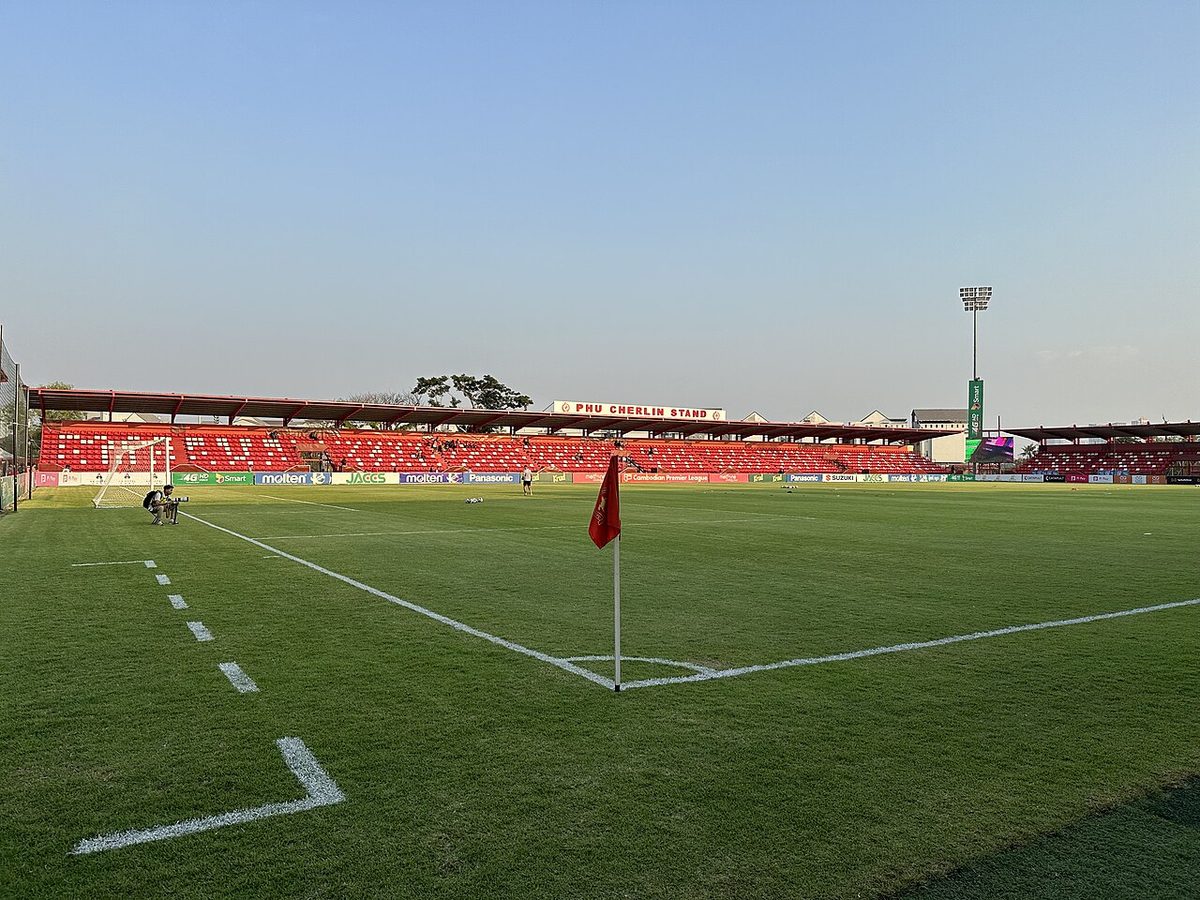
Crowds have not followed. According to the attendance records for recent seasons, a CPL match drew an average of 1,243 spectators in 2024-25 and 1,291 in 2025-26. The lowest crowds were 101 in 2024-25 and 160 in 2025-26, both at Kirivong Sok Sen Chey's home ground. The league's own figure for the whole of week 16 in 2025-26 was 6,507 spectators.
Neighbouring leagues draw far more. In 2025-26 the average was 3,931 in the Malaysia Super League, 5,202 in Thai League 1 and 6,372 in Indonesia's Super League. One Thai club, Buriram United, averaged 18,203 at home.
The demand is there, on big days
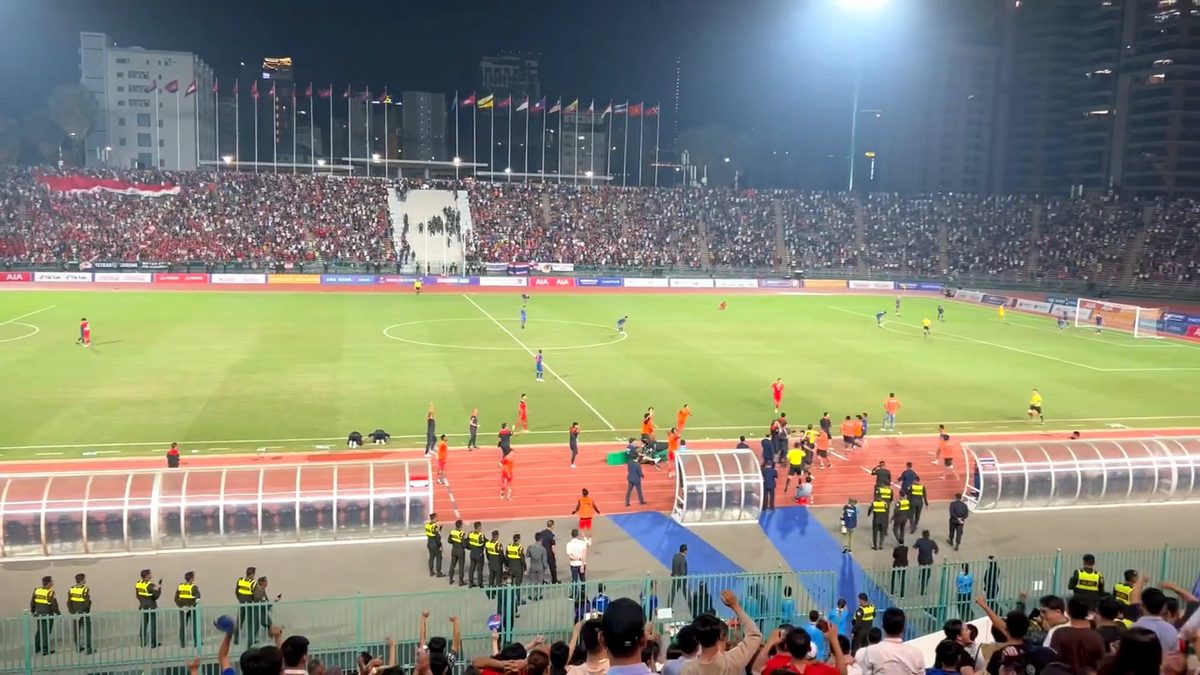
When a match feels like an event, Cambodians come. The 2025 AFC Challenge League final between Svay Rieng and Arkadag of Turkmenistan drew 51,610 to Morodok Techo National Stadium on 10 May 2025. More than 53,000 tickets had been sold days before, the Phnom Penh Post reported. In the same season the league average was 1,243.
Boeung Ket against Svay Rieng on 27 December 2025 drew 20,005, the highest league crowd of 2025-26. The 2026 Krud Cambodian Super Cup drew 12,891, 69% more than the previous edition's 7,614, after the league added a halftime concert by Cambodian artists and shirt and ball giveaways, the CPL said.
The gap between those nights and an ordinary weekend suggests the problem is not a lack of interest in football, but how ordinary league matches are offered.
A Cambodian success story: Angkor Tiger
The best local example of building a fan base from almost nothing is in Siem Reap. Japanese businessman Akihiro Kato bought the club, then called Cambodian Tiger, in 2015 and moved it from Phnom Penh to Siem Reap in 2017.
In a 2019 account of the project, Kato wrote that when he took over, about 200 people came to matches, mostly players' and staff's families and friends, and that the club was almost unknown in Siem Reap. By 2019, he wrote, the club's attendance was five to six times the league average, it had won the league's award for the best-attended club two years in a row, and a supporters' group called the Tiger Army had formed. The club was also named the most popular club at the 2018 Cambodia Football Awards.
The club kept investing in the match-day experience. It worked with Wonderpass on what Khmer Times called the country's first "digital stadium", and opened its own Akihiro Kato Stadium in November 2024, which Khmer Times described as a new fan favourite. Kato has said he wants to make the club a tourism and entertainment hub for Siem Reap, Kiripost reported. On the pitch, Angkor Tiger finished third in 2025-26 and scored 71 goals.
Angkor Tiger shows that three things work in Cambodia: a club that belongs to one province with no rival nearby, a stadium sized for its crowd, and an owner who treats match day as a product.
Five pain points in the numbers
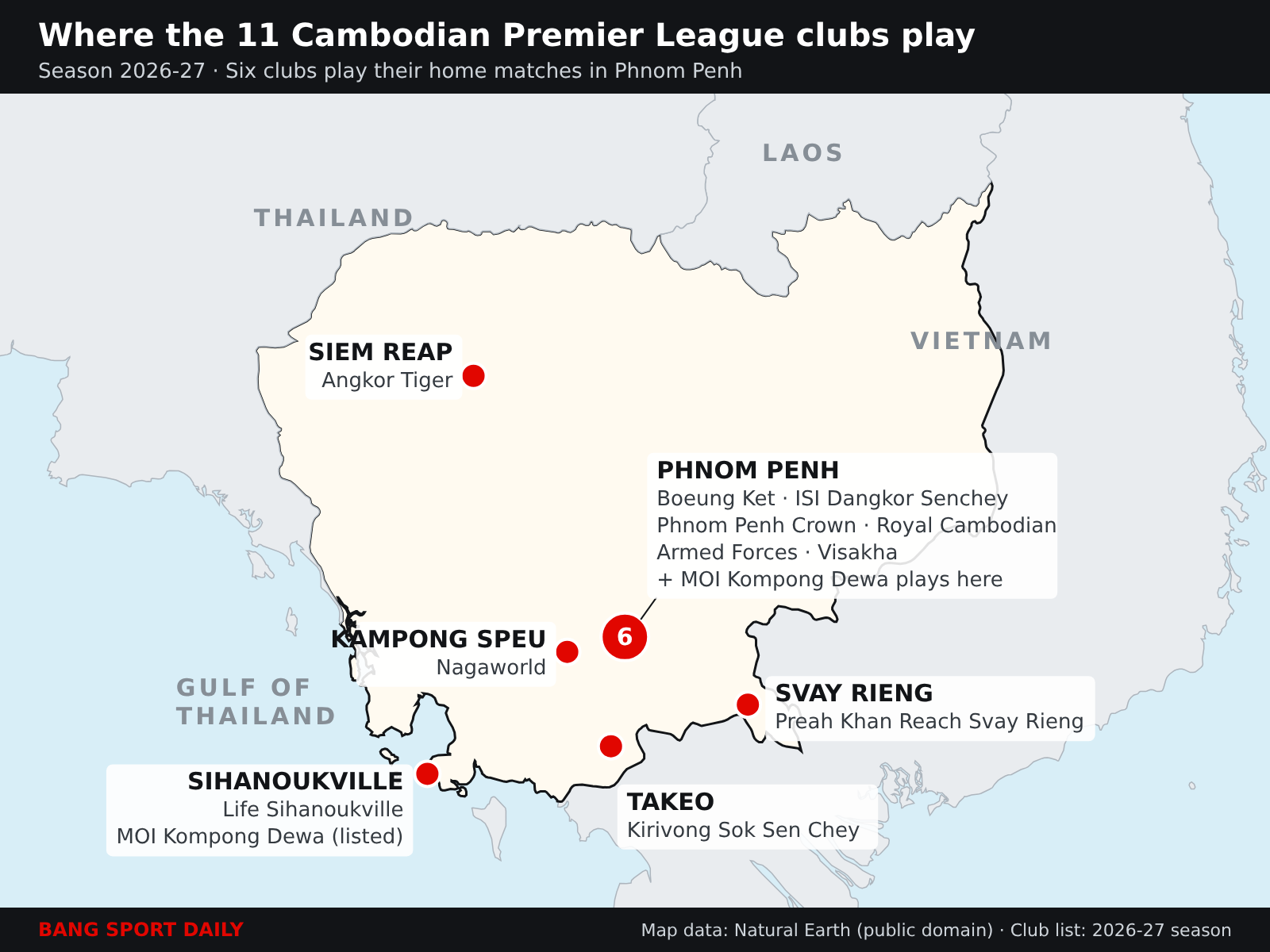
1. Clubs without a hometown. Several clubs carry the name of a company or institution rather than a place. MOI Kompong Dewa is listed in Sihanoukville but plays at Visakha Stadium in Phnom Penh, which it shares with Visakha. Fans need a reason to belong, and a city or province is the most common one.
2. Too many clubs in one city. Five of the 11 clubs are based in Phnom Penh, and a sixth plays its home games there. They compete for the same fans.
3. The wrong size of stadium. Big matches are played in national stadiums with tens of thousands of seats, where 2,000 people look like an empty ground. Other clubs play in very small grounds. Kirivong Sok Sen Chey Stadium is listed at 250 seats.
4. No published club-by-club data. The league publishes weekly totals, but not average crowds for each club, ticket sales or app audiences, so clubs cannot measure what works.
5. A thin commercial base. The league has no title sponsor. Its partners are Molten, Metfone, Krud, Indomie and V-Active, and the champion's prize is US$50,000. Clubs depend heavily on their owners, with little money for marketing.
What has worked abroad
Japan: data and new audiences. The J.League drew a record 12.5 million spectators in 2024, 14% more than in 2023, according to Brand Finance. Its "J.League ID" membership links fans to clubs and players. Gamba Osaka used that data to divide fans into groups and send them different emails, and shifted its focus towards families. Kashima Antlers, where 30 to 40% of fans are women, has run "Dear Ladies" match days since 2022. The league also stages "Kokuritsu Day" matches at the National Stadium in Tokyo with music and events for people who rarely attend football.
Thailand: one province, one club. Buriram United made its 32,000-seat Chang Arena the main attraction of a province of 1.6 million people, Main Stand reported. It made its own shirts and kept the price at 690 baht while brand-name kits cost 890 to 1,900 baht, and it holds concerts and festivals at the stadium. In 2019 it took 27.4 million baht from merchandise on a single matchday.
Club by club: where each one stands
The figures below are from the 2026-27 club list and the last two seasons' records. Stadium capacities differ between sources, so the 2026-27 list is used.
Preah Khan Reach Svay Rieng (Svay Rieng, Svay Rieng Stadium, 7,002 seats; champions in 2023-24, 2024-25 and 2025-26). The 51,610 at the AFC final shows the club can draw a national audience. The next step is to bring that pride home: regular events at Svay Rieng Stadium, school and family tickets in the province, and a membership card that rewards fans who attend both league and Asian matches.
Phnom Penh Crown (Phnom Penh, Phnom Penh Crown Stadium, 4,712 seats; the most successful club in league history, runners-up in 2025-26). Its own stadium and its run in Asia are the strongest base in the capital. A J.League-style membership, linked to tickets and the CPL+ app, would turn its Asian campaign into season-long loyalty.
Boeung Ket (Phnom Penh, National Olympic Stadium, 35,000 seats; four league titles since 2012, fourth in 2025-26). The 20,005 crowd against Svay Rieng proves the club can fill large stands for the right match. It could fix a few "big match" dates each season, like Japan's Kokuritsu Day, with entertainment around the game, and use a smaller, fuller section of the stadium for ordinary matches.
Visakha (Phnom Penh, Visakha Stadium, 6,835 seats; third in 2024-25, seventh in 2025-26, runners-up in the 2026 Super Cup). Visakha drew the highest league crowd of 2024-25, 5,438 against Angkor Tiger. With a stadium of under 7,000 seats, the club can aim for full stands, and use winning runs to sign up members and build a supporters' section.
Angkor Tiger (Siem Reap, Akihiro Kato Stadium, 3,700 seats; third in 2025-26). The model for the league. Its next opportunity is tourism: tickets and match packages sold through hotels and tour operators in one of Southeast Asia's best-known tourist cities.
ISI Dangkor Senchey (Phnom Penh, Smart Stadium, 2,980 seats; eleventh in 2025-26). A stadium of under 3,000 seats is the right size for a full, loud ground. In a crowded capital, the club needs a clear district identity, built through local schools and neighbourhoods, as Japanese clubs do.
Nagaworld (Kampong Speu, Kampong Speu Stadium, 2,350 seats; former champions, most recently in 2018, fifth in 2025-26). The club is based in Kampong Speu province but is still known by its sponsor's name. Building its identity around Kampong Speu, as Angkor Tiger did around Siem Reap, is the clearest path to local fans.
MOI Kompong Dewa (listed in Sihanoukville, plays at Visakha Stadium in Phnom Penh; last in 2024-25 with 8 points, sixth in 2025-26). The club improved sharply on the pitch, but it has no home ground of its own in the city where it is listed. A permanent home and a local name are the first steps before any fan programme.
Royal Cambodian Armed Forces (Phnom Penh, RCAF Old Stadium, 7,500 seats; ninth in 2025-26). The army club has a natural community in soldiers, their families and nearby neighbourhoods. Organised family days and free entry for children would turn that community into a regular crowd.
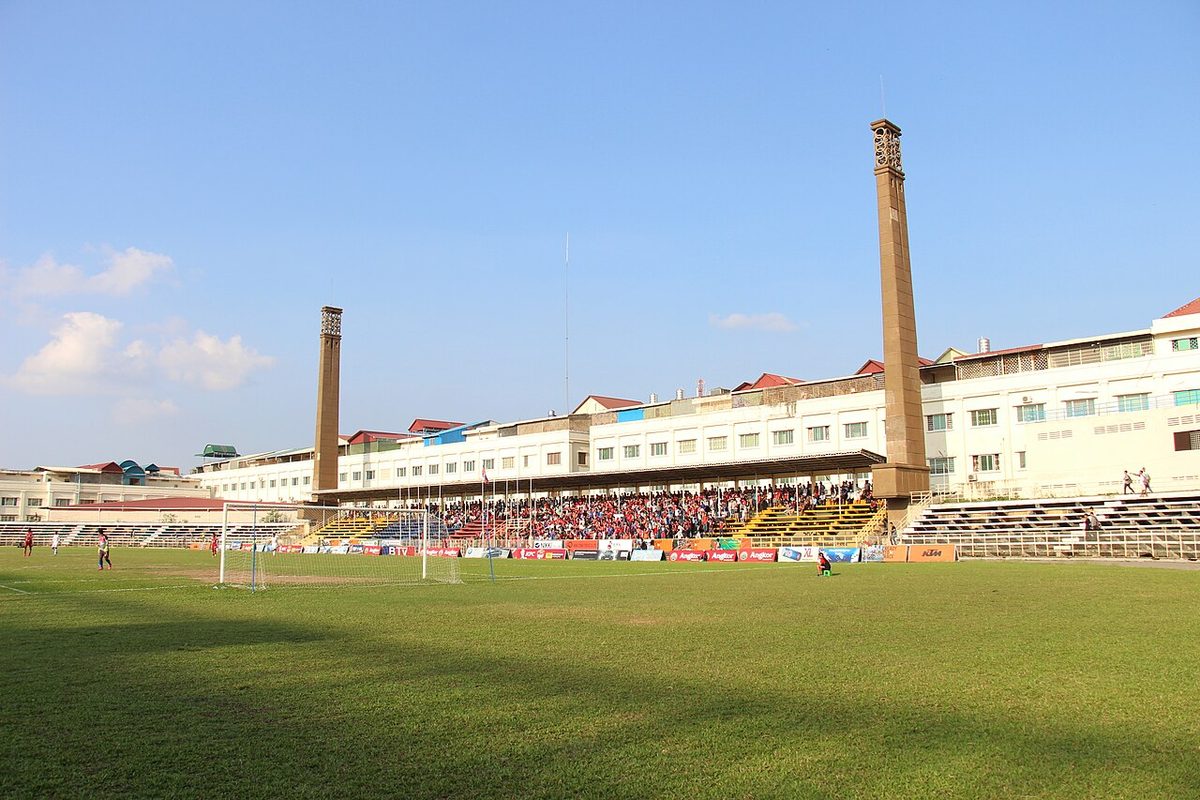
Kirivong Sok Sen Chey (Takeo, Kirivong Sok Sen Chey Stadium, 250 seats; eighth in 2025-26). The club recorded the league's lowest crowds in both seasons. As the only top-flight club in Takeo province, it has the "one province, one club" position that worked for Buriram and Angkor Tiger. Links with schools, local businesses and the provincial administration, and affordable local shirts, are the low-cost first steps.
Life Sihanoukville (Sihanoukville, Life Stadium, 2,200 seats; tenth in 2025-26). Backed by Life University, the club can draw on students and staff as a ready-made base, with student tickets and campus events. Sihanoukville's visitors are a second audience.
How AI and technology could help
The CPL+ app already gives the league a direct link to every viewer. With simple, low-cost tools it could be used to:
- Know the fans. Linking app accounts, ticket purchases and memberships, as the J.League ID does, would show who watches, where they live and which matches they choose.
- Target the right people. As Gamba Osaka did, clubs can send different offers to families, students and fans who only watch on the app.
- Plan match days. Per-club data on crowds, kick-off times, weather and opponents lets simple prediction models show which slots draw the most people.
- Speak to fans in Khmer, fast. AI tools can produce short highlight clips with Khmer subtitles within minutes of the final whistle, and answer ticket and fixture questions through chatbots in the apps fans already use.
- Measure and publish. Weekly average attendance for each club would make progress visible and give sponsors the numbers they need.
What happens next
The 2026-27 CPL season continues into 2027, while Phnom Penh Crown and Svay Rieng play the rest of their Champions League Two groups. Results in Asia, and examples such as Angkor Tiger's, show what is possible. Whether the stands fill will depend on the work done at each club, week by week.